





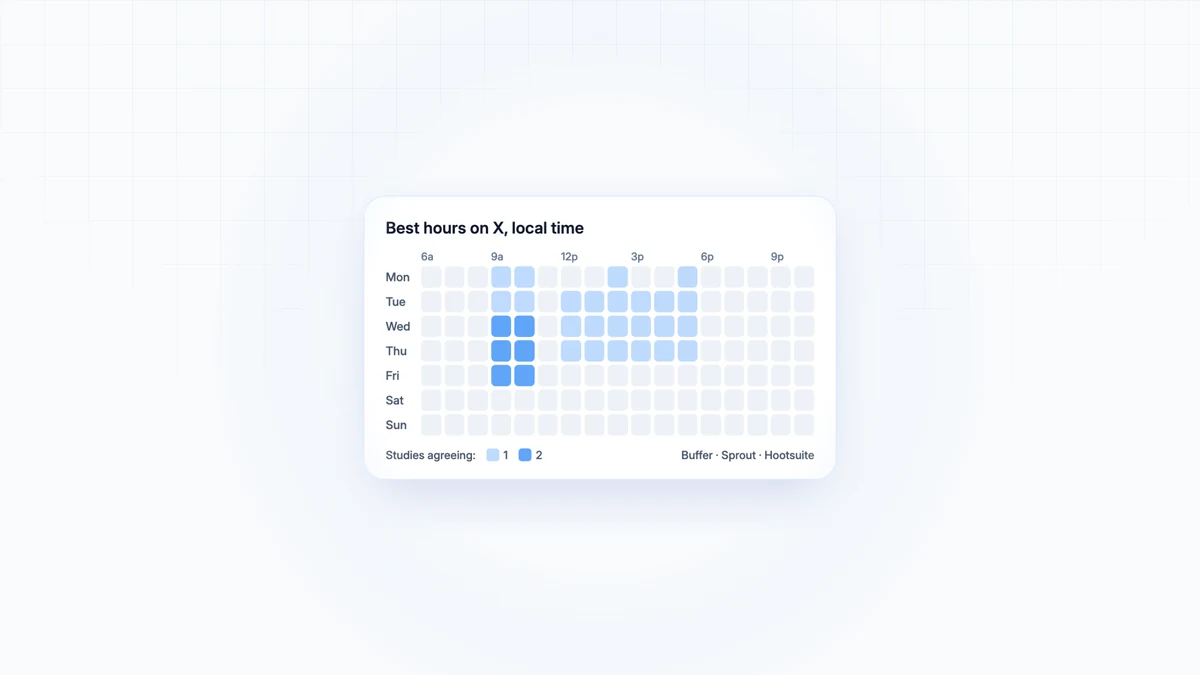
The best time to post on X is a weekday morning or early afternoon, Tuesday to Thursday, in your audience's local time. Three studies published in the past year agree on the days and disagree on the hours: Buffer and Hootsuite found 9 to 11 a.m., Sprout Social found noon to 6 p.m. All three found the weekend weakest.
The short version: post on X between 9 a.m. and 6 p.m., Tuesday to Thursday, in your followers' time zone, and avoid Saturday. Inside that window, the studies split between mornings (Buffer, Hootsuite) and afternoons (Sprout), so test both for two weeks and keep the hour your own posts reward. A study tells you where to start; your analytics tell you where to stay.
What is the best time to post on X (Twitter)?
Tuesday to Thursday, between 9 a.m. and 6 p.m. local time. That is the window every recent study shares. Within it, Buffer's data points to 9 a.m. on Tuesday as the single strongest hour, and Sprout Social's to the afternoon. If you post once a day, start at 9 or 10 a.m. on weekdays and move later only if your own numbers say so.
Here is what each study actually measured. They are not the same thing, which is why their answers differ.
| Study | Data | Best time on X | Worst |
|---|---|---|---|
| Buffer, March 2026 | 8.7 million posts sent through Buffer, ranked by engagement rate | Tuesday 9 a.m., then Wednesday 10 a.m. and 9 a.m.; weekdays 9–11 a.m. most reliable | Saturday, then Friday; evenings |
| Sprout Social, March 2026 | Nearly 2 billion engagements on about 307,000 profiles across six networks, November 2025 to February 2026 | Tuesday to Thursday, 12–6 p.m.; Monday 2–3 p.m. and 5 p.m. | Saturday and Sunday |
| Hootsuite, November 2025 | More than 1 million posts across networks, with Critical Truth, normalised across 118 countries | Wednesday to Friday, 9–11 a.m. | Not stated for X |
All times are local to the audience. Figures read from each study's own page on October 18, 2026.
Why do the studies disagree?
Because they measure different accounts with different yardsticks. Buffer ranks hours by engagement rate on posts its own customers scheduled. Sprout counts engagements on the profiles its customers manage, across six networks, over one winter quarter. Hootsuite pools posts from every network and normalises the hours across 118 countries. Each sample is mostly businesses that pay for a scheduling tool, which is not the same crowd as a founder posting from a phone.
The useful reading is the overlap, not any one number. Midweek beats the weekend in all three. Daytime beats the evening in all three. Everything finer than that depends on whose followers you have.
What is the worst time to post on X?
Saturday, and weekday evenings after 6 p.m. Buffer found evenings from 6 to 11 p.m. the weakest hours on every day of the week, and Saturday the weakest day, followed by Friday. Sprout found both weekend days weakest. If your audience is not in one time zone, the worst time is whichever hour falls at night for most of them.
Does it matter what time you post on X?
Less than what you post, but yes. Most people see a post in the hours after it goes out, so a post that lands while your followers are asleep starts with nobody to read it. Timing cannot rescue a weak post. It can stop a good one from going unseen.
Two habits matter more than the exact hour. Post when you can stay around for the first replies, because a conversation keeps a post in front of people. And post consistently: a steady weekday rhythm at a decent hour beats a perfect hour you hit twice a month.
How to find your own best time to post on X
- Find where your followers are. If most of them are in one region, use its local time. If they are split, pick the hours where the regions' working days overlap.
- Pick two slots inside the shared window. One morning (9 or 10 a.m.) and one afternoon (2 or 3 p.m.), Tuesday to Thursday.
- Alternate them for two weeks. Similar posts, same days, only the hour changes.
- Compare the results. Open each post's stats (the bar-chart icon under it) and compare engagement per impression, not raw likes, so one lucky post does not decide it.
- Keep the winner and test again next quarter. Audiences shift; a rule you set once goes stale.
In Skryvo this is the Performance page: it measures the best hour on each channel from your own published posts, and "Use best times" makes that hour the default for new posts. Until you have a few weeks of posts, start from the shared window above.
Best time to post on X by day
| Day | Start here (local time) | Why |
|---|---|---|
| Monday | 2–3 p.m. | Sprout's Monday peak; mornings go to inboxes |
| Tuesday | 9 a.m. | Buffer's top hour of the week |
| Wednesday | 9–10 a.m. | Top three in Buffer, inside Hootsuite's window |
| Thursday | 9–11 a.m. or 12–3 p.m. | Inside all three studies' windows |
| Friday | 9–11 a.m. | Hootsuite's window; Buffer ranks Friday second-weakest |
| Saturday | Skip, or post only if your audience is consumers | Weakest day in Buffer and Sprout |
| Sunday | Afternoon at most | Weak in Sprout's summary |
The table is a starting point built from the studies above, not a measured result of ours. Your own two-week test overrides it.
Schedule the week, then stop thinking about it
Once you know your hours, the time of day stops being a decision. Write the week's posts in one sitting, or turn one blog post into a week of them, check each against X's 280-character limit, and schedule them for the slots you picked. Then spend the posting hour replying to people instead of watching the clock.

Let your agent write the next one in your voice
Skryvo drafts each post in your saved voice and publishes it after your go-ahead. Free to start.