





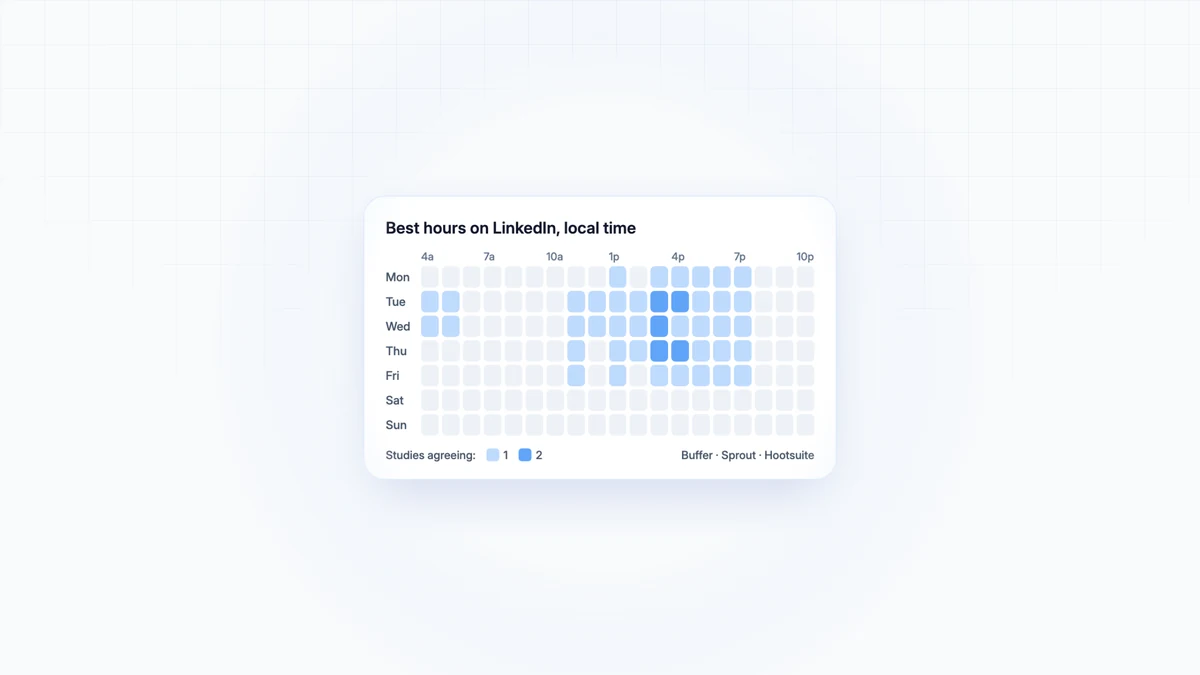
The best time to post on LinkedIn is a weekday, Tuesday to Thursday, but the studies disagree on the hour by more than ten hours. Hootsuite found 4 to 6 a.m., Sprout Social found late morning to mid-afternoon, and Buffer's latest study found 3 to 8 p.m. All of them found weekends weakest.
The short version: post on a weekday, Tuesday to Thursday if you can, in your audience's time zone, and skip the weekend. For the hour, start in the window two studies share, 11 a.m. to 5 p.m., then test one early-morning slot and one late-afternoon slot against it for two weeks. The studies cannot agree on the hour, so the hour is the thing to measure yourself.
What is the best time to post on LinkedIn?
Tuesday to Thursday, between 11 a.m. and 5 p.m. local time, is the safest starting point: it sits inside Sprout Social's daily windows and overlaps the start of Buffer's. If you post once a week, Wednesday afternoon is the slot two of the three studies rate well. After that, your own analytics should decide.
Here is what each study measured and found, read from their own pages on October 18, 2026:
| Study | Data | Best time on LinkedIn | Worst |
|---|---|---|---|
| Sprout Social, 2026 | 2 billion engagements across 307,000 profiles | Mon 1–2 p.m.; Tue 11 a.m.–5 p.m.; Wed 11 a.m.–4 p.m.; Thu 11 a.m. and 1–5 p.m.; Fri 11 a.m. and 1–2 p.m. | Saturday and Sunday |
| Buffer, 2026 | 4.8 million posts sent through Buffer | Weekdays 3–8 p.m.; top slots Wednesday 4 p.m., Friday 3 p.m. and 4 p.m. | Weekends |
| Hootsuite, 2025 | More than 1 million posts across networks, with Critical Truth | Tuesday and Wednesday, 4–6 a.m. | Not stated |
All times are local to the audience.
Why do the studies disagree so much?
Because each one measures its own customers, with its own yardstick, in its own year. Buffer ranks hours by engagement on posts its users scheduled. Sprout counts engagements on the profiles its customers manage across six networks. Hootsuite pools posts from every network and normalises the hours across 118 countries, which can pull a global average toward hours that are morning somewhere and evening somewhere else.
The answers also move over time. In July 2024, LinkedIn's own marketing blog summarised Buffer's then-new data as "between 9 am and 5 pm on weekdays". The same LinkedIn article lists HubSpot and Sprinklr findings that differ again. Buffer's 2026 study now puts the peak at 3 to 8 p.m. When the same company's answer shifts by hours in two years, treat any single hour as a starting guess.
What survives every study: weekdays beat weekends, and midweek is strong. Everything finer depends on whose followers you have.
What is the worst time to post on LinkedIn?
Saturday and Sunday. Every study above rates the weekend lowest, which fits a network people use for work. For weekday evenings the studies split: Sprout's windows all close by 5 p.m., while Buffer's newest study found engagement holding until 8 p.m.
Does the time you post on LinkedIn matter?
Yes, but less than what you post. LinkedIn's own article makes the same point: timing plays a role, but the substance of the post matters more, and LinkedIn has said it gives more weight to knowledge and insight in the feed. A strong post at an average hour beats a weak post at the perfect one. If you want the substance part, how to write a LinkedIn post people read covers it.
Timing matters most in the first hour, when your own network sees the post and decides whether to react. Post when you can stay around to answer the first comments.
How to find your own best time to post on LinkedIn
- Check where your audience works. LinkedIn's analytics show your followers' locations. Use the time zone most of them are in.
- Pick three slots to test. One early (7–8 a.m.), one midday (12–1 p.m.), one late afternoon (4–5 p.m.), all Tuesday to Thursday.
- Rotate them for three weeks. Similar posts, only the hour changes.
- Compare engagement per impression, not raw reactions, so one post that travelled does not decide it.
- Keep the winner, retest each quarter. Audiences and the feed both change.
In Skryvo, the Performance page measures the best hour on each channel from your own published posts, and "Use best times" makes it the default for new posts. Until you have a few weeks of posts, the shared window above is the place to start.
Best time to post on LinkedIn by day
| Day | Start here (local time) | Why |
|---|---|---|
| Monday | 1–2 p.m. | Sprout's Monday window |
| Tuesday | 11 a.m.–5 p.m. | Sprout's longest window; Hootsuite's early slot is the test alternative |
| Wednesday | 3–4 p.m. | Inside Sprout's window and Buffer's top slot (4 p.m.) |
| Thursday | 1–5 p.m. | Inside Sprout's window, overlaps Buffer's |
| Friday | 1–3 p.m. | Sprout's 1–2 p.m. and Buffer's 3 p.m. |
| Weekend | Skip | Weakest in every study |
This table is a starting point drawn from the studies above, not a result we measured. Your own three-week test overrides it.
Set the hours once, then write
Pick your slots, put them in your scheduler, and stop deciding the hour every day. Scheduling LinkedIn posts takes a minute in LinkedIn's own composer or in a tool. Spend the time you save on the post itself, and on the first hour of comments.

Let your agent write the next one in your voice
Skryvo drafts each post in your saved voice and publishes it after your go-ahead. Free to start.