Of 900,000 web pages created in a single month, 2.5% were written purely by AI. Pure human pages were 25.8%. Everything else — 71.7% — was a mix of the two, according to Ahrefs' measurement of new pages. The "AI versus human" debate is over, and both sides lost. The web is already hybrid.
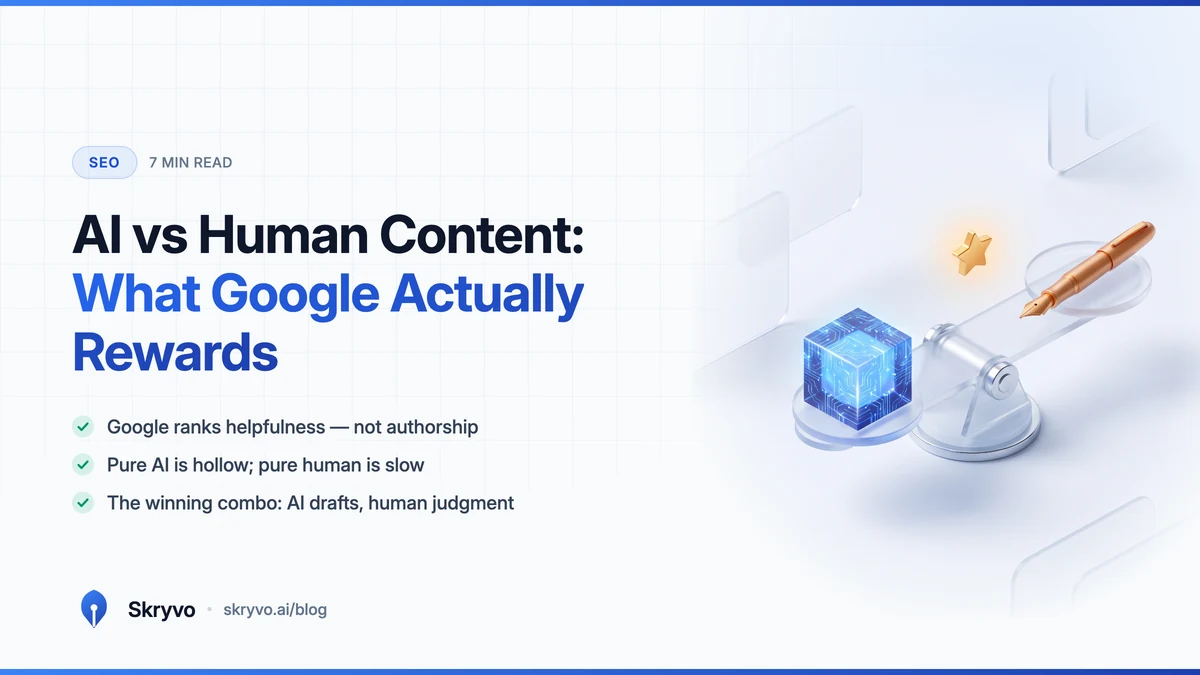
The short version: measured studies show fully-AI and fully-human articles at rough parity, with most new content a blend. The viral "90% AI by 2026" figure was a 2022 projection, not a measurement. Google rewards neither camp — it rewards helpfulness — and the winning workflow is a measured hybrid: AI drafts, human judgment, verified facts.
Is there more AI content on the internet than human content?
For fully AI-generated articles: roughly equal, not dominant. Graphite tracked 65,000 articles published between 2020 and 2025 and found AI-written pieces briefly overtook human ones in late 2024, then settled at parity — "AI-written pages haven't overwhelmed human content", as Axios put it. The bigger truth is the blend: most new pages are neither purely one nor the other.
But wasn't it supposed to be 90% by 2026? That number is worth a fact-check, because it is everywhere. It traces to a 2022 Europol foresight report on deepfakes — an expert projection made before anyone had measurement data, in a document about synthetic media threats, not web publishing. The measured reality came in far lower. This is exactly why we trace statistics to their primary source before citing them: the most viral numbers are routinely the least verified.
How do you tell AI content from human content?
On any single page, you mostly cannot — detectors are noisy and false-flag real writers. What readers actually detect is stylistic: watermark vocabulary, uniform structure, flat rhythm, and the absence of anything only the author could know. Those tells are countable and fixable — which is precisely why "was this AI?" is the wrong question. The useful question is whether the page is worth anyone's time.
What Google actually rewards
Helpfulness, indifferent to authorship — and this is now measured, not just stated. Ahrefs also studied 331,000 pages against their rankings and found no penalty for AI-assisted content; what correlates with rankings is the same as ever — pages that answer the query with substance. The policy details and the workflow that stays on the right side of them are in the ranking guide.
Where each side actually fails
Pure AI is fluent and hollow. It compresses the consensus, invents details under confidence, and adds nothing the top ten results lack — fine for a first draft, fatal for a finished page. Pure human is slow and inconsistent: small teams cannot hold a competitive cadence by hand, and quality swings with whoever was tired that week. Each side's weakness is the other side's strength, which is why the measured web converged on the blend.
The combination that wins — measured, not vibes
The hybrid only works if you hold it to a standard. Here is ours, as a receipt: when we shipped Skryvo's trainable brand voice, we refused to merge it until a live evaluation showed AI-voiced output scoring at least as well as unvoiced output on every content surface, with zero banned phrases in the results. It passed, and that gate still runs. That is what "AI plus human" should mean in practice — the machine drafts fast, the pipeline verifies facts and scores quality, and a human adds the judgment and signs their name.
Stop picking a side. The web already did — it picked both. Compete on the only axis left: whether the finished page is accurate, specific, and worth citing.
Write content you can publish with confidence
Skryvo generates, fact-checks, and scores your content — try it free.